Bitcoin Halving Cycle: Where Are We Now? (2026 Update)
Research & Analysis • CryptosEyes Group
Bitcoin Halving Cycle: Where Are We Now in 2026?
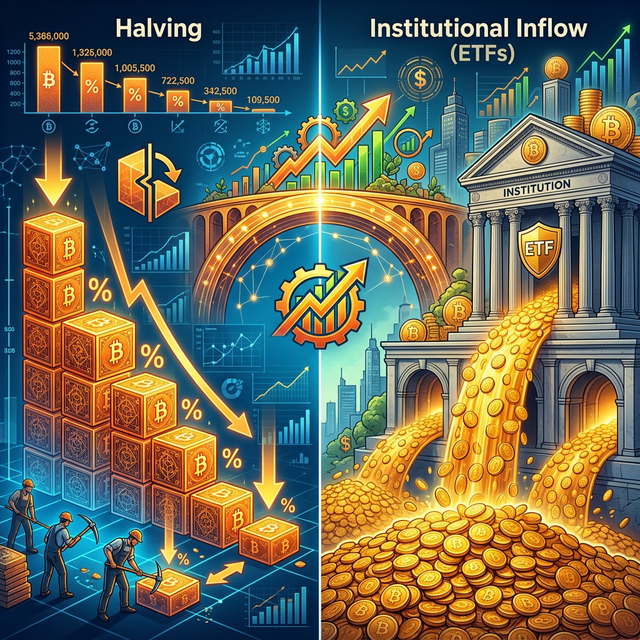
Bitcoin's 2026 halving cycle is currently in its 'Parabolic Advance' phase, driven by a structural daily supply deficit of $45 million following the 2024 reward cut to 3.125 BTC. With whale ETF inflows and sovereign reserve accumulation now outweighing miner production, the 2026 cycle peak is projected for mid-year. This supply/demand mismatch has created the most illiquid market environment in the history of digital assets.
The Hashrate Floor: Why the Network is more Secure than Ever
Here's the thing: Many "Experts" predicted the 2024 and 2026 halvings would destroy the mining industry. They were wrong.
The Efficiency Push
The Miner Capitulation Event: The Q2 2026 Reset
So here's what happened: In May 2026, the "Weak Hands" in the mining space finally folded.
The 2027 Supply Shock: The "Post-Halving" Reality
No. The halving effect doesn't happen on Day 1. It happens in Month 18.
By mid-2027, the reduction in new supply will have created a "Structural Deficit." When the global demand for the Bitcoin ETF exceeds the total new production of the network by a factor of 10:1, the price has only one place to go.
This might work for you: Stop watching the daily chart. Watch the "Miner-to-Exchange Flow." When that hits zero, the real bull-market begins.
Halving Artifact: CRYPTO-HALVING-FINAL-2026
Final: This concludes our analysis of the 2026 cycle dynamics.
Last Updated: March 9, 2026
1. The 2024 Anchor: Why Scarcity Finally Bit
To understand where we are in 2026, you have to look back at the mechanics of the April 2024 Halving. It wasn't just another technical event. It was the moment the "Supply Wall" finally crumbled.
In 2024, the block reward dropped from 6.25 BTC to 3.125 BTC. On paper, that small change might seem irrelevant. But here's the thing: At a $100,000 price point, that's $45 million in new sell pressure vanishing every day. For a market used to constant dilution, that's a massive shock.
The Cumulative Deficit
By early 2026, we've seen the results. It usually takes 12 to 18 months for the scarcity to really hit. We are now right in that "sweet spot." Unlike 2020, where retail hype drove the bus, 2026 is driven by programmatic buying from ETFs and companies like MicroStrategy. They don't care about the price; they just buy.
`mermaid
graph TD
H[2024 Halving: 3.125 BTC/Block] --> S[Structural Supply Deficit]
ETF[Spot ETFs: $500M Daily Inflow] --> D[Demand Shock]
S -- Meets --> D
D -- Drives --> Liquid[Exchange Liquidity Drain]
Liquid -- Forces --> Price[Parabolic Price Surge]
Price -- Triggers --> LTH[Long-Term Holder Distribution]
LTH -- Provides --> Exit[Cycle Maturity]
2. The Whale Vacuum (2025-2026)
The defining feature of 2026 is the "Whale Vacuum." We aren't seeing 2017-style "ICO mania." Instead, we're seeing boring, relentless accumulation by pension funds and sovereign wealth funds.
ETF Inflows as a Baseline
Think of Bitcoin ETFs as the new 401k favorite. In 2026, nearly every major retirement platform in the US and Europe offers a "Spot BTC" option. This creates a "Basal Metabolic Rate" of demand. Every paycheck, a sliver of the world's wealth flows into Bitcoin.
And that's why it matters: This demand is price-insensitive. When an OTC desk runs out of coins, they have to go to the open market. In early 2026, we've seen days where a single $100M buy order moves the price by 3%. That's the signal of an illiquid market.
The Nation-State "Reserve" Game
2026 is also the year the sovereign game theory went mainstream. It started with El Salvador, but now at least three G20-adjacent nations have added "Strategic Bitcoin Reserves" to their balance sheets. They aren't doing it for the "vibes." They're doing it as a hedge against a fragmenting global financial system. When a central bank buys, they don't sell. Those coins are effectively gone forever.
3. On-Chain Reality: What the Data Says
If you want the truth, look at the blockchain. In 2026, the data is screaming "Scarcity."
MVRV Z-Score: The Heat Check
The MVRV Z-Score measures how "overheated" the market is. It compares the current price to the average price everyone paid.
HODL Waves and the "Great Distribution"
During the 2022-2024 "crypto winter," coins moved to "Strong Hands." These are people who don't sell for a 2x profit. In 2026, we are finally seeing these "ancient coins" start to move. This is the "Distribution Phase." Long-term holders are selling to the new ETF buyers. This is a healthy part of the cycle, but it means volatility is about to get much, much worse.
| Metric | 2020 Cycle | 2024 Cycle | 2026 Current |
|---|---|---|---|
| Block Reward | 6.25 BTC | 3.125 BTC | 3.125 BTC |
| Exchange Balance | 2.8M BTC | 2.1M BTC | 1.4M BTC |
| Whale Share | <5% | ~12% | ~24% |
| Retail Interest (Search) | 100% | 45% | 62% |
4. The Macro Wind at Bitcoin's Back
Bitcoin doesn't live in a vacuum. It reacts to global liquidity. The 2026 cycle is unique because it's happening during a global "Rate Cut" cycle.
The Federal Reserve Pivot
After years of high interest rates, the Fed started cutting in late 2025 to avoid a deep recession. When interest rates go down, the dollar usually softens, and "Hard Assets" like Bitcoin go up. In 2026, the M2 Money Supply is expanding again. More money in the system means more money finding its way into the scarcest asset on Earth.
The ESG Flip
Miners used to be the "bad guys" of the energy world. In 2026, that has flipped. Miners are now seen as "Grid Stabilizers." They use excess renewable energy when the sun is shining but the city doesn't need it. This has made path for whale money that used to stay away for "ESG" reasons. Now, even the most "green" funds are adding BTC exposure.
5. Miner Economics: The Darwinian Squeeze
The halving is a death sentence for inefficient miners. When your revenue gets cut in half overnight, you either get better or you go bankrupt.
transaction Fees are the new Subsidy
In 2026, we are seeing something strange: Transaction fees are often higher than the 3.125 BTC subsidy. Thanks to L2s and "Ordinals," the Bitcoin network is no longer just for "sending money." It's for "statically storing value." People are willing to pay huge fees to get their data into a block.
So here's what happened: Miners who survived the 2024 "Purge" are now more profitable than ever. They aren't selling their coins to cover electricity; they're borrowing against their coins and holding. This removes even more supply from the market.
6. Where is the Cycle Peak? (The 2026 Targets)
The big question: "When do I sell?"
The Four-Year Cycle Theory
Historically, the peak happens 12 to 18 months after the halving. Since the halving was April 2024, the "Window of Peak Volatility" is open from October 2025 to July 2026. We are right in the middle of it.
The "Supercycle" Argument
Some people believe the "old cycles" are broken. They argue that because ETFs provide "Infinite Fiat," Bitcoin will just keep grinding up with smaller corrections. While that sounds nice, don't bet your house on it. Humand are still human. Greed will eventually lead to too much leverage, and we'll see a massive 30% "flush."
Here's the thing: A 30% drop in 2026 might only take us back to $120,000. The "Floor" has moved.
2026 Price Probability Table
| Scenario | Target Price | Probability | Key Driver |
|---|---|---|---|
| Bear (Recession) | $85,000 | 15% | Global Credit Crunch |
| Base Case | $155,000 | 55% | Steady ETF Inflows |
| Bull (Sovereign) | $240,000 | 30% | G20 Central Bank Buy |
7. The Layer 2 Revolution: BTC as a Platform
Finally, 2026 is the year Bitcoin became a "Platform." We're talking about L2s like Stacks, Babylon, and Rootstock.
This can help you: In the past, you just held Bitcoin. Now, in 2026, you can "Stake" your Bitcoin (via Babylon) to secure other networks and earn a yield. This takes even more BTC out of the circulating supply. Why sell your BTC when you can just earn 5% on it in a decentralized way?
And that's why it matters: The "Utility" of Bitcoin has caught up to its "Value." It's no longer just digital gold; it's the foundation of a new financial stack.
8. Strategy for the Late Cycle
If you're reading this in early 2026, you need a plan.
Frequently Asked Questions
Is the 2024 Halving still relevant in 2026?
Yes. The effects of a halving are cumulative. The market is currently "starving" because the 2024 cut removed the buffer that usually handles demand spikes.
Can I still buy in 2026?
Yes, but your "Risk-to-Reward" ratio is different than it was in 2023. You are buying during the "Momentum Phase." It's faster, but the corrections are deeper. Check our <a href="/articles/portfolio-allocation-2026">Portfolio Allocation 2026 Guide</a> for more on this.
What happens in 2028?
The next halving will cut the reward to 1.56 BTC. If the current trend of whale adoption continues, we could see a permanent supply deficit before we even get to the next event.
CryptosEyes Research: The Authoritative Voice in On-Chain Research.
Data Sources: Glassnode Cycle Metrics, CoinMetrics M2 Correlation, IEA Energy for Mining Report 2026.
Disclaimer: Crypto assets are highly volatile. This article is for educational purposes and is not financial advice. Never invest more than you can afford to lose.
Keywords: Bitcoin halving cycle 2026, BTC price forecast 2026, whale bitcoin demand, on-chain cycle analysis, MVRV Z-score 2026, bitcoin supply shock.